1960
The source
Roger Corman shoots The Little Shop of Horrors, a low-budget black comedy film, in a matter of days.
Original FilmA low budget horror comedy that inspired the musical.

A meek florist, a hungry plant and a shop on Skid Row.
Seymour Krelborn works at Mushnik’s failing flower shop on Skid Row. He finds a strange plant, names it Audrey II after the coworker he secretly loves, and business booms. Then he learns what it eats.
Seven people and a very large plant.
From a quick B-movie to a five-year Off-Broadway run, a film and revivals that keep coming.
Roger Corman shoots The Little Shop of Horrors, a low-budget black comedy film, in a matter of days.
Original FilmA low budget horror comedy that inspired the musical.
Howard Ashman (book, lyrics, direction) and Alan Menken (music) open the musical Off-Off-Broadway in May.
Off Broadway MusicalThe musical became a surprise hit, gaining popularity for its dark humor and catchy music.
On July 27 the show transfers to the Orpheum Theatre in the East Village, Off-Broadway.
Off Broadway TransferThe move to a bigger downtown house gave the show room to grow into a long-running hit.
Wins best musical from the New York Drama Critics’ Circle, the Drama Desk and the Outer Critics Circle.
Critical AcclaimMajor New York critics’ awards confirmed the show as one of the best musicals of the season.
Frank Oz directs the movie musical with Rick Moranis as Seymour and Ellen Greene reprising Audrey.
Movie AdaptationThe successful musical was adapted into a movie with a bigger budget, famous cast, and a rewritten ending.
The Orpheum run closes on November 1 after five years and 2,209 performances.
Long Run EndsAt closing it was one of the longest-running musicals in Off-Broadway history.
The first Broadway production opens at the Virginia Theatre.
Broadway FlopThe show moved to Broadway with a much larger production but struggled to recreate its original success.
An Off-Broadway revival opens at the Westside Theatre with Jonathan Groff as Seymour.
Off Broadway RevivalThe musical returned to a smaller theater, embracing its original charm and finding renewed success.
I saw the revival Off-Broadway at the Westside Theatre in New York, with Skylar Astin as Seymour.
Seeing It LiveThe revival is still running today, with a rotating line of stars taking over as Seymour.
Off-Broadway in 1982, the 1986 film, and Broadway in 2003: what critics and audiences thought, and whether it paid off.
“The revival isn’t Broadway-slick, and that’s to its advantage.”
Melissa Rose Bernardo · New York Stage Review · October 17, 2019“A model show for Off Broadway”
Edith Oliver · The New Yorker · Sept. 20, 1982“On Broadway, the pumped-up ‘Little Shop’ has sacrificed a lot of its lovableness.”
Peter Marks · The Washington Post · Oct. 2, 2003“Little Shop of Horrors isn’t uniformly entertaining, nor is its score always entirely audible; the musical dubbing is at times very awkward.”
Janet Maslin · The New York Times · Dec. 19, 1986“The show’s inherent heart and plaintive charms have been eviscerated.”
Matthew Murray · Talkin’ Broadway · Oct. 2, 2003“Everything seems bloated and relentless.”
Howard Kissel · New York Daily News · Oct. 2003Three songs. Three themes. One deadly story.
House lights down. One last reel.
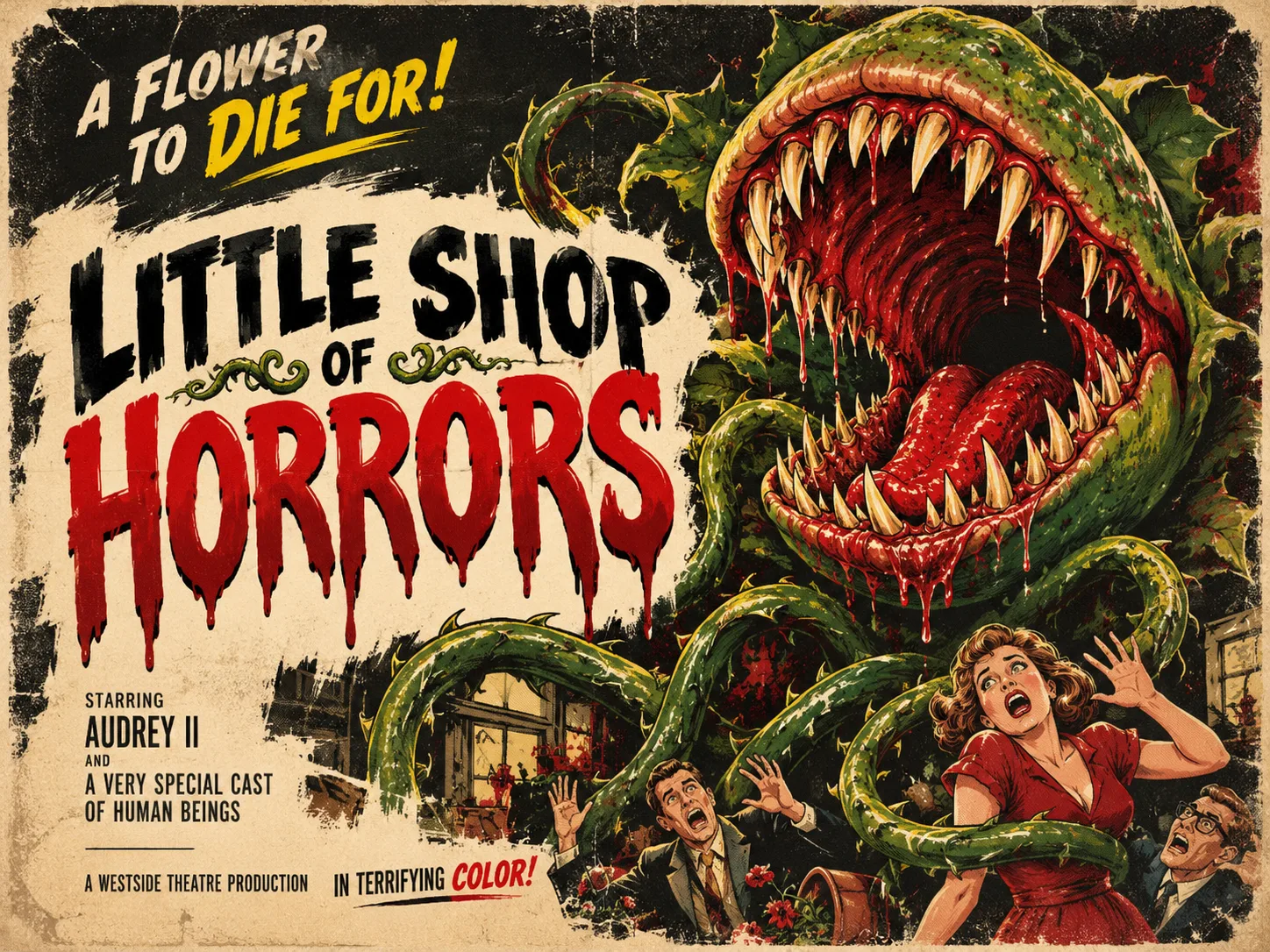
The partnership went on to write The Little Mermaid, Beauty and the Beast and Aladdin for Disney.
A fixture of high school, college and community theater for four decades.
Revived in 2019 at the Westside Theatre, with Jonathan Groff as Seymour.

Seymour wants three things: Audrey, a way off Skid Row, and to be somebody. Audrey II can give him all three, as long as he keeps it fed, and each wish is paid for by someone else. Under the songs and the jokes, it is a story about a deal with the devil, set in a flower shop.
Seymour trades his conscience for fame and fortune, and the plant’s price keeps rising. Written at the start of the 1980s, the show pokes at greed, celebrity and the urge to sell out. In the finale the cast turns to the audience and sings the warning straight at them: don’t feed the plants.
Seven actors, one set and a small band. It was written for Off-Broadway and needs nothing more.
Audrey II is played by four puppets of increasing size. In a small house the last one fills the stage and leans over the front row.
Crystal, Ronnette and Chiffon sing straight out to the seats, so the audience ends up on Skid Row with everyone else.
 Book & lyrics by Howard Ashman · Music by Alan Menken